
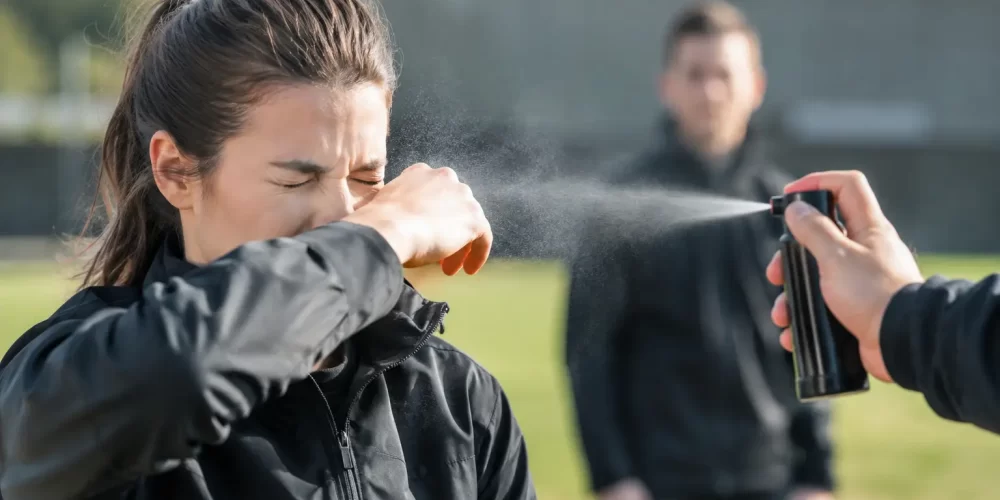
What OC Spray Exposure Training Actually Proves
A security professional should never learn what OC spray feels like during a live incident. The pressure, loss of visual clarity, breathing discomfort, and urgency to act can change how a person communicates and makes decisions. OC spray exposure training puts that reality into a controlled training environment, where participants can learn to recover, follow commands, and remain accountable when conditions are difficult.
For professionals who carry or may work alongside chemical agents, this training is not about proving toughness. It is about readiness. A meaningful credential shows employers, agencies, and clients that the holder understands the effects of OC spray, respects its limitations, and has been assessed under stress.
Why OC spray exposure training matters
Oleoresin capsicum, commonly called OC or pepper spray, is often described as a less-lethal force option. That description can be misunderstood. Less-lethal does not mean harmless, consequence-free, or appropriate for every confrontation. Improper deployment, poor aftercare, weak communication, or an inability to control the situation after deployment can turn a force option into a serious operational failure.
Exposure training gives the learner firsthand context. It demonstrates that a subject affected by OC may be disoriented, angry, frightened, physically resistant, or only partially impaired. The expected effects vary from person to person. A spray may create enough distance to disengage safely, but it may not immediately stop a determined assault. Personnel must be prepared to transition to positioning, verbal direction, communication with partners, restraint procedures when authorized, and medical or emergency support when needed.
That is why quality training places chemical-agent education within a force-management framework. The goal is not to make OC spray the answer to conflict. The goal is to help professionals recognize when force is justified, apply the least reasonable level of force permitted by law and policy, and manage the incident after the spray is deployed.
Exposure is not a toughness test
A common mistake is treating OC exposure as an initiation ritual. That approach has little professional value. A participant does not become more qualified simply because they endured discomfort. The value comes from the tasks performed afterward and the instructor-led evaluation of those tasks.
Following controlled exposure, a trainee may need to orient themselves, communicate clearly, locate a designated position, make appropriate decisions, or complete an approved defensive or control sequence. The exact exercise should match the role, local requirements, instructor standards, and agency policy. A healthcare worker, for example, may need a different scenario than an event-security professional or a private protection agent.
The objective is composure under impairment. Can the learner keep listening? Can they use clear commands? Can they avoid striking the wrong person, escalating the wrong encounter, or contaminating others? Can they recognize when to disengage and call for assistance? These are professional questions, not tests of bravado.
What a credible OC certification should cover
A well-structured OC course is broader than the exposure event. It should prepare learners to make defensible decisions before, during, and after a chemical-agent deployment. Online learning can effectively cover policy, theory, reporting, legal considerations, and safety principles. Practical instruction is necessary when the course includes hands-on handling, scenario work, or an exposure component.
A complete program should address the following areas:
- The effects, capabilities, and limitations of OC products and delivery systems.
- Reasonable-force decision-making, duty-of-care expectations, and employer or agency policy.
- Verbal de-escalation, distance, positioning, and situational awareness before force becomes necessary.
- Safe deployment principles, including environmental hazards and the risk of affecting bystanders, partners, or enclosed spaces.
- Post-deployment control, decontamination, medical escalation, incident reporting, and evidence preservation.
The best instruction connects these subjects instead of presenting them as separate boxes to check. A security officer who understands spray mechanics but cannot explain why force was necessary is not fully prepared. Likewise, someone with strong verbal skills who does not understand cross-contamination risks may create a new hazard after an otherwise justified response.
The operational reality after deployment
The moment OC is used, the job changes. Personnel may be dealing with an affected subject, bystanders, coworkers, cameras, supervisors, and later, written reports. The initial use of force is only one part of the event.
A trained professional should recognize the need to create safety, communicate what happened, monitor the subject, and request appropriate assistance under site policy. They should also understand that contamination can spread through close contact, clothing, ventilation, and shared spaces. Recovery procedures must be handled according to the product guidance, organizational protocol, and the person’s condition. If someone shows signs of medical distress, emergency care takes priority.
Training should also reinforce the importance of precise reporting. Documentation should explain the behavior observed, de-escalation efforts attempted when feasible, the reason force became necessary, the type of force used, actions taken afterward, witnesses, notifications, and any injuries or medical response. Reports based on vague statements such as “the subject was aggressive” do not show sound judgment. Specific, objective facts do.
Who benefits from this qualification
OC spray exposure training is relevant to more than traditional security guards. Loss-prevention teams, event-security staff, private agency personnel, executive protection professionals, workplace safety teams, and certain frontline employees may all benefit when their duties place them near conflict or chemical-agent response procedures.
Still, certification does not automatically authorize anyone to carry or use OC spray. Authorization depends on state and local law, employer policy, contract requirements, licensing rules, and the responsibilities of the role. Some workplaces prohibit chemical agents entirely because of the environment, population served, or contamination risk. Hospitals, schools, transit settings, and crowded venues may require stricter controls or different response options.
For that reason, professionals should choose training that strengthens judgment rather than encouraging a one-size-fits-all response. A qualification has greater career value when it shows an employer that the learner understands restraint, documentation, and accountability alongside physical response skills.
How to evaluate a training program
Before enrolling, look past the word “certified.” Ask what the course actually assesses. Does it explain when OC may be used and when it should not be used? Does it include de-escalation and post-incident responsibilities? Are practical components supervised by qualified instructors? Is the completion credential clear enough to support an employment file, agency record, or professional portfolio?
Delivery format also matters. An online course can be an efficient way to build foundational knowledge and earn documentation of completed instruction. If your employer requires live exposure, spray handling, or scenario evaluation, confirm that the course provides an approved in-person component or that a qualified instructor can assess those skills. The right format depends on your job requirements, not on convenience alone.
At GC Tactical Training, learners can pursue force-management education that connects OC spray knowledge with de-escalation, personal protection standards, and practical certification credentials. For professionals building a security career, that connection matters. Employers need people who can do more than carry equipment. They need people who can make disciplined decisions when an incident becomes unpredictable.
Build confidence that holds up under pressure
The strongest security credentials are not collected for a resume alone. They represent training that changes how a professional responds when a subject is combative, a crowd is watching, and every action may be reviewed afterward.
Choose OC spray exposure training that challenges your decision-making, reinforces lawful and responsible force management, and prepares you to care for the scene after force is used. That preparation can protect your career, your team, and the people placed in your care.