
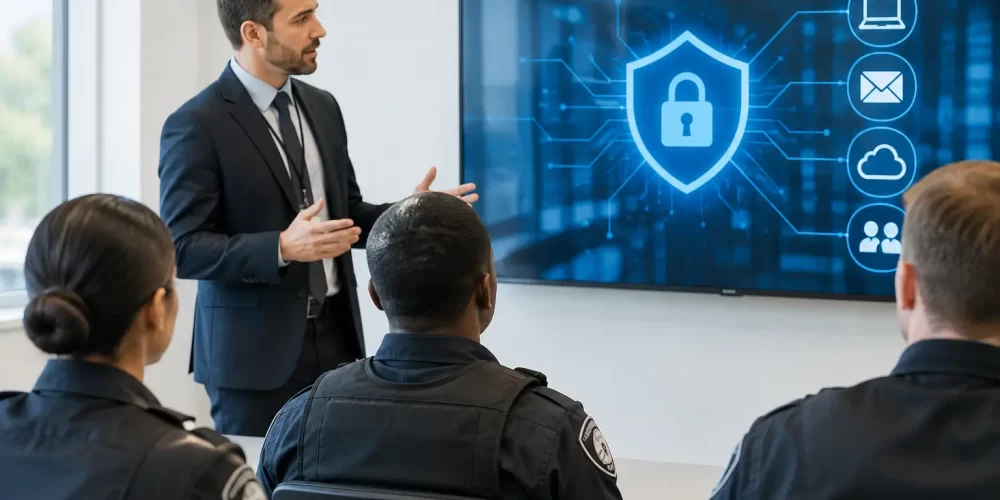
Cybersecurity Training for Frontline Security Staff
A security officer at a front desk may be the first person to spot an unauthorized visitor, a stolen access card, or a suspicious package. They may also be the first person to receive a phishing email, take a call from someone seeking employee information, or use a shared device that holds sensitive incident records. Cybersecurity training prepares frontline professionals to recognize these risks before a minor mistake becomes an operational, financial, or safety incident.
For security guards, loss-prevention personnel, event staff, workplace safety teams, and protection professionals, cyber awareness is no longer separate from physical security. It is part of professional readiness. The goal is not to turn every learner into an IT specialist. The goal is to build disciplined habits that protect people, property, records, and the organization’s reputation.
Why Cybersecurity Training Belongs in Security Work
Security work is built on observation, access control, documentation, communication, and proper response. Those same responsibilities exist in a digital setting. A compromised password can open doors to schedules, camera systems, visitor logs, patrol reports, employee records, and internal communications. A careless response to a fake email can expose an entire workplace.
Frontline staff are often targeted because they handle information, control access, and interact with the public. Attackers may pose as managers, vendors, delivery personnel, police officers, IT support, or concerned customers. They may use urgency, authority, fear, or confusion to pressure someone into sharing information or bypassing a procedure.
Proper training teaches personnel to slow down, verify identity, and follow reporting procedures. That response is familiar to anyone trained in conflict management or use-of-force decision-making. Acting quickly is not the same as acting correctly. A professional response is controlled, documented, and based on policy.
What Effective Cybersecurity Training Should Cover
A useful introductory course should focus on situations learners can encounter during a normal shift. Technical jargon has limited value if a learner cannot identify a suspicious request, protect a login, or report a possible breach through the correct chain of command.
Phishing and Social Engineering
Phishing is one of the most common ways criminals gain access to accounts and information. A phishing message may look like a notice from a supervisor, payroll department, scheduling system, bank, delivery company, or software provider. It may ask the recipient to reset a password, open an attachment, confirm a payment, or sign in through a fraudulent page.
Social engineering extends beyond email. It can happen by text message, phone call, social media, or in person. A caller who claims to be from IT may ask for a verification code. A visitor may claim they were sent to pick up equipment. A stranger may ask an employee to hold a secure door open because their badge is not working.
The details change, but the method remains similar: create pressure, appear legitimate, and persuade someone to ignore procedure. Cybersecurity training should teach staff to independently verify unusual requests rather than relying on a name, logo, or confident tone.
Passwords, Multi-Factor Authentication, and Device Security
A strong password is only one part of account protection. Personnel should understand why passwords must not be shared, written where others can see them, or reused across work and personal accounts. If a single password is exposed, reused credentials can give an attacker access to multiple systems.
Multi-factor authentication adds another layer by requiring a second form of verification, such as an authentication app or a code. Staff must also understand that a verification code should never be shared with an unexpected caller or message sender. If someone asks for a code, they may be attempting to enter the account at that exact moment.
Device security matters just as much. A workstation left unlocked at a reception desk, security office, retail back room, or event command post can expose operational information. Personnel should lock screens when stepping away, protect mobile devices, use approved networks, and avoid connecting unknown USB devices or personal storage media to workplace equipment.
Sensitive Information and Incident Documentation
Security professionals routinely handle information that should not be discussed publicly. This may include employee names, visitor records, camera locations, access procedures, incident reports, medical information, client details, or patrol schedules. Even information that seems ordinary can become useful to someone planning theft, harassment, fraud, or unauthorized entry.
Training should establish clear judgment around what can be shared, who is authorized to receive it, and how records should be stored. A report may be professionally written and factually accurate, but it can still create risk if it is emailed to the wrong person, left on a printer, or discussed in a public area.
The right approach depends on the workplace and local requirements. A hospital, retail location, corporate office, residential property, and event venue will not all use the same systems or policies. The underlying standard is consistent: treat operational and personal information as a security responsibility.
The Physical and Digital Security Connection
Physical security and cybersecurity meet at access points. Badge readers, surveillance systems, alarm panels, electronic visitor systems, digital keys, and mobile reporting platforms all depend on people using them properly. A lost access card, an unattended tablet, or an unauthorized person following someone through a controlled door can create both physical and digital exposure.
This is why security personnel should question unusual conditions without making assumptions. A badge that fails repeatedly may be a technical issue, but it may also require verification. A person who knows internal names and procedures may still be unauthorized. Familiarity is not proof of authorization.
The strongest teams apply the same principles online and on site: verify credentials, maintain boundaries, document concerns, and escalate when necessary. These practices support prevention without creating unnecessary confrontation.
How to Respond to a Suspected Cyber Incident
The first few minutes after a suspected incident matter. Employees should not attempt to investigate beyond their authority, delete evidence, or continue entering information into a suspicious form. They should preserve the situation, report it promptly, and follow organizational procedures.
A practical response may include disconnecting a device from the network if policy directs it, notifying a supervisor or designated IT contact, documenting what happened, and identifying any accounts or systems involved. If an unknown person gained physical access to a restricted area or device, that should be reported as both a physical and cybersecurity concern.
Staff should avoid embarrassment-driven decisions. People often delay reporting because they clicked a link, entered information, or believe they made a mistake. Early reporting gives the organization a better chance to reset credentials, review access logs, contain the issue, and protect others. Reporting is a professional responsibility, not an admission of failure.
Choosing Cybersecurity Training That Supports Your Career
For professionals entering security or adding qualifications, foundational cybersecurity education should be practical, recognized, and relevant to real workplace responsibilities. Look for training that explains threat recognition, information handling, password safety, access control, reporting, and policy awareness in direct language.
Completion credentials can also support professional development. A digital certificate, wall certificate, or wallet-size ID card provides evidence that a learner has completed formal instruction and taken steps to strengthen their qualifications. This is especially useful for candidates seeking security assignments where reports, access systems, customer data, or surveillance technology are part of daily duties.
At the same time, learners should understand the limits of an introductory credential. Foundational cybersecurity training does not replace specialized IT certifications, network administration experience, or an employer’s internal procedures. It does show that a security professional understands the human side of cyber risk and can work more responsibly around digital systems.
GC Tactical Training positions cybersecurity education alongside force-management, de-escalation, workplace safety, and personal protection instruction because frontline readiness is not limited to one type of threat. A well-qualified professional can recognize the warning signs of a conflict, an access-control failure, or a digital deception and respond within policy.
Make Cyber Awareness Part of Your Shift
Cybersecurity is most effective when it becomes routine. Verify unexpected requests. Protect your credentials. Lock the device when you leave it. Keep sensitive reports out of public view. Report suspicious activity early and document facts clearly.
Those actions may seem small, but security failures often begin with small gaps in attention or procedure. Build cyber awareness into the same professional discipline you bring to patrols, access control, incident reporting, and conflict prevention. Your ability to protect a workplace increasingly depends on both what you see in front of you and what you recognize on a screen.
Leave a Reply
You must be logged in to post a comment.