
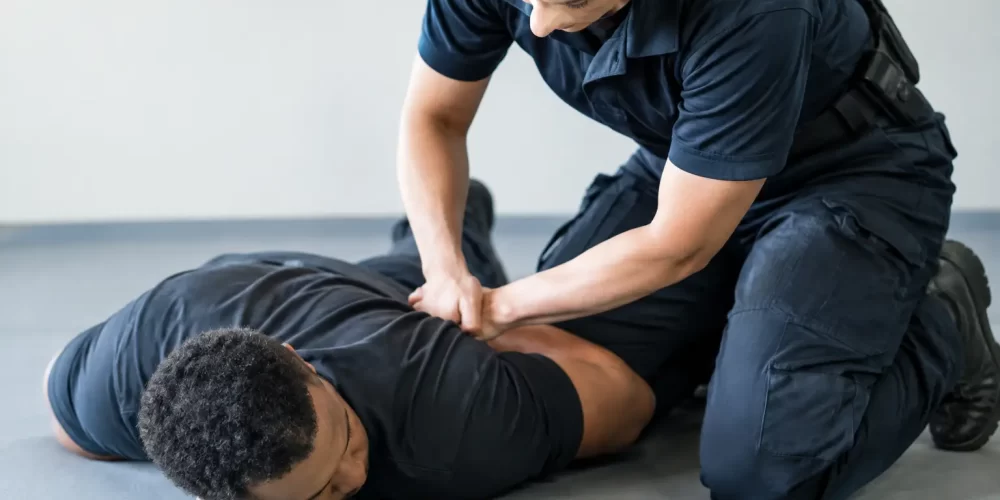
Preventing Positional Asphyxia During Restraint
A restraint can appear controlled and still become a medical emergency within seconds. Preventing positional asphyxia during restraint is not simply a matter of choosing an approved technique. It requires trained judgment before, during, and immediately after physical control is applied. For security professionals, the standard is clear: use the least force reasonably necessary, end physical restraint as soon as it is safe, and treat changes in breathing, consciousness, or behavior as urgent warning signs.
What positional asphyxia means in a restraint
Positional asphyxia occurs when a person’s body position interferes with their ability to breathe effectively. Pressure on the back, chest, abdomen, or neck can reduce breathing. So can a position that leaves the person bent forward, compressed against an object, or unable to expand their chest. The danger can increase when a person is handcuffed behind the back, exhausted from struggling, intoxicated, medically compromised, or experiencing a behavioral health crisis.
The practical lesson is that a person who is resisting is not necessarily breathing safely. Struggle, yelling, and movement can create the mistaken impression that there is no medical concern. A person may become quiet, weak, confused, or unresponsive after an intense struggle. That change demands immediate attention, not a delayed report or a decision to wait for additional staff.
Security personnel are not expected to diagnose medical conditions. They are expected to recognize risk, stop creating avoidable danger, request emergency medical assistance when needed, and provide care within their training and workplace protocol.
Why restraint situations become high-risk
Physical restraint is rarely a single isolated skill. It is a fast-moving event involving force decisions, communication, environmental hazards, the subject’s condition, and the number and training level of staff on scene. A technique may be appropriate at the start of an incident but become unsafe when the person’s position, behavior, or medical status changes.
Risk is often higher when several factors occur together. A person may be in a prone position, have their hands restrained behind their back, and be held down by one or more responders. They may also be affected by alcohol or drugs, severe agitation, fatigue, obesity, a respiratory condition, heart disease, or an unknown medical issue. No single factor guarantees harm, but each one should raise the responder’s level of caution.
The environment matters as well. Tight spaces, stairs, vehicles, crowds, furniture, and hard surfaces can make it difficult to reposition a person safely. A rushed response can lead staff to prioritize control over assessment. Professional force management requires both. Control must be maintained without continuing a position that compromises breathing.
Preventing positional asphyxia during restraint
The safest restraint is the one that is avoided through early communication, distance, teamwork, and de-escalation. When physical intervention is necessary to prevent immediate harm, responders should use only trained, policy-authorized methods. Improvised holds, punishment-based force, and techniques that restrict the neck or compress the torso create unacceptable risk.
Avoid prolonged prone restraint whenever possible. If a person has been brought to the ground, the priority is to move them out of a face-down position as soon as control permits. Do not place body weight across the person’s back, chest, or abdomen. Do not use knees, feet, or equipment to pin the torso. Do not leave a restrained person bent over or folded at the waist, including while seated, against a wall, or in a vehicle.
Once handcuffs or another authorized restraint device is applied, reassess the need for continued hands-on control. Secure restraint does not justify continued compression or a hazardous body position. Place the person in a safer recovery-oriented position consistent with agency policy and training, monitor them continuously, and never assume the incident is over because the cuffs are on.
Clear team communication reduces dangerous overlap. One responder should communicate with the restrained person when possible. Another should observe breathing, skin color, consciousness, and body position. Team members should state what they see: “Move off the back,” “They are not responding,” or “Call EMS now.” Direct language prevents critical warnings from being lost in the stress of the event.
Watch for changes, not just obvious symptoms
A person in respiratory distress may not always say they cannot breathe. They may be unable to speak clearly, too confused to respond, or deteriorating rapidly. Security staff should remain alert for labored, shallow, irregular, or absent breathing; bluish or gray lips and skin; sudden quietness after active resistance; loss of consciousness; vomiting; seizures; or an inability to sit upright or maintain posture.
Complaints of chest pain, trouble breathing, dizziness, weakness, or a medical condition should be taken seriously. The same applies when a person says they have asthma, heart problems, are diabetic, or have taken medication or substances. Do not argue about whether the complaint is genuine. Reduce physical pressure, reposition when safe, call for medical assistance, and continue observation.
A person who becomes unresponsive requires immediate emergency action. Activate emergency medical services, follow your organization’s emergency procedures, and begin first aid or CPR only if trained and indicated. If an AED is available, have it brought to the scene. Maintain scene safety, but do not allow concerns about paperwork, custody, or embarrassment to delay care.
Do not confuse compliance with safety
A restrained person may become still because they are exhausted, injured, unconscious, or unable to breathe adequately. Quietness is not proof that the person is calm or safe. This is why continuous observation matters from the first physical contact through transfer of custody or EMS arrival.
If the person is transferred to law enforcement, medical personnel, or another supervisor, communicate what happened. Include the force used, the approximate duration of the struggle, restraint position, reported medical concerns, visible symptoms, and any care provided. Accurate handoff information supports continuity of care and professional accountability.
Training decisions that reduce risk
Training should build more than mechanical restraint skills. Personnel need scenario-based practice that connects verbal de-escalation, team movement, safe positioning, cuffing procedures, medical recognition, radio communication, and post-incident responsibilities. Staff should understand when to disengage, when to request backup, and when an emergency medical response is the priority.
Supervisors and employers should establish clear policies on prohibited positions, continuous monitoring, emergency activation, documentation, and reporting. Policies must align with applicable laws, local regulations, contracts, and organizational requirements. A certificate is valuable evidence of completed instruction, but it does not replace agency policy, recurring practice, or sound decision-making in the field.
Refresher training is particularly valuable for staff who rarely use physical restraint. Skills can degrade, and staff may remember how to gain control while forgetting the medical safeguards that follow. Effective instruction reinforces that force is dynamic: responders must continually assess whether the level and method of force remain reasonable, necessary, and safe.
GC Tactical training supports professionals who want stronger qualifications in force management, handcuffing, verbal de-escalation, and workplace safety. Those qualifications should reinforce a disciplined operational mindset: protect people, recognize changing risks, and act within your training and authority.
Documentation is part of the safety response
After the scene is stable, document the event while details are fresh. Record the reason for intervention, efforts to de-escalate, the force and restraints used, the person’s positions, monitoring observations, medical complaints, EMS activation, witnesses, and transfer of custody. Write objective facts rather than conclusions or assumptions.
Thorough documentation does more than protect an organization after an incident. It identifies training gaps, supports supervisory review, and helps teams recognize patterns that could lead to future harm. If a procedure repeatedly requires staff to use risky positions because of staffing, equipment, or environmental limitations, that is an operational issue worth correcting.
Every restraint should end with the same professional question: Is this person breathing, conscious, positioned safely, and receiving the level of care the situation requires? That question keeps the focus where it belongs – on responsible control, immediate safety, and the standard of care that trained security professionals are expected to deliver.
Leave a Reply
You must be logged in to post a comment.