
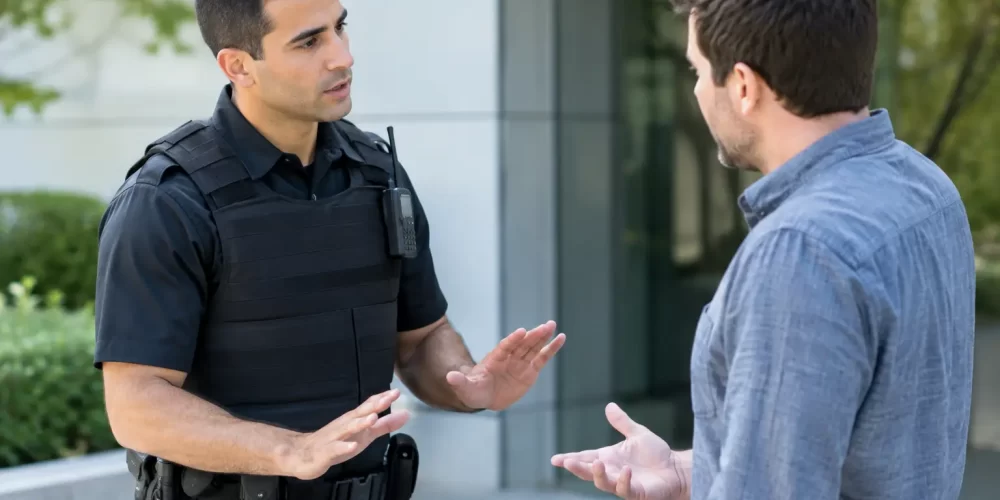
Best De-Escalation Techniques for Security Guards
A routine trespass call can turn physical in less than a minute. A raised voice, a crowd gathering, a person who feels cornered, or an officer who moves too quickly can change the outcome. The best de-escalation techniques security guards use are not passive communication tricks. They are professional response skills that create time, distance, options, and safer decisions before force becomes necessary.
For security personnel, de-escalation protects more than the person in front of you. It protects bystanders, clients, your employer, your professional reputation, and your ability to explain every decision after an incident. It also supports a core force-management principle: use only the level of control that is reasonable, necessary, and appropriate to the situation.
Best De-Escalation Techniques Security Guards Need
Effective de-escalation starts before the first word. A guard who arrives visibly tense, stands too close, blocks an exit, or issues commands without understanding the situation may unintentionally increase resistance. Your first task is to assess what is happening, identify immediate risks, and choose a position that supports communication and safety.
Maintain a reactionary gap. Do not crowd a person who is upset, intoxicated, confused, or showing signs of aggression. Stand at an angle rather than directly squared up whenever practical, keep your hands visible and ready, and avoid placing yourself between the person and a safe route away from the conflict. Positioning is not weakness. It is professional preparation.
Your voice matters as much as your words. Speak slowly enough to be understood, use a calm volume, and give one clear instruction at a time. A rapid series of demands can sound like a challenge, especially when a person is already stressed or embarrassed in public. Firm communication does not require yelling.
Start by identifying yourself and your purpose. For example: “I’m security for this property. I need to speak with you about what happened.” This establishes authority without making unnecessary accusations. If you need compliance, explain the specific behavior that must change: “Please lower your voice and step over here with me so we can talk away from the entrance.”
Listen for the Problem Behind the Behavior
Many confrontations are driven by a person’s need to be heard, respected, or given a path to leave without losing face. Listening does not mean agreeing with threats, abusive language, or rule violations. It means gathering information while showing that you understand the concern.
Use short, practical statements such as, “I can see you’re frustrated,” or, “Tell me what you need right now.” Avoid saying “calm down.” People rarely experience that phrase as help. They often hear it as dismissal.
Reflect the relevant issue back to the person. If a guest is angry because they believe they were treated unfairly, acknowledge the concern without making promises you cannot keep: “You feel you were singled out. I hear that. Right now, I need you to stop confronting staff so we can address this safely.” This separates the person’s concern from the unacceptable behavior.
Ask open questions when the environment allows it. “What happened before I arrived?” and “What would help you leave this area safely?” can reveal whether the person is seeking information, medical assistance, a supervisor, transportation, or simply a respectful exit. If there is an immediate threat, direct commands and emergency procedures take priority over conversation.
Give Clear Choices, Not Empty Threats
A person under stress may struggle to process complex instructions. Reduce the decision to a clear choice with realistic consequences. The goal is voluntary compliance, not winning an argument.
For example: “You can leave through the front exit now, or you can wait here while law enforcement is called. Which do you prefer?” Both options must be lawful, within site policy, and something you are actually prepared to carry out. Do not threaten arrest, physical force, or consequences outside your authority.
Good choices give the person control over how they comply. They should be specific, achievable, and stated without sarcasm. A guard who says, “Do what I say or else,” has created uncertainty. A guard who explains the next step has created a decision point.
Allow a brief pause after giving directions. Silence can feel uncomfortable, but immediately repeating yourself, moving closer, or adding more demands may increase pressure. Watch body language during that pause. Clenched fists, blading the body, scanning for exits, reaching into clothing, pacing, or sudden changes in breathing may require you to adjust your distance, request assistance, or transition to a higher level of response.
Control Your Own Nonverbal Signals
Security guards are constantly assessed by the people they contact. Your posture, facial expression, distance, hand placement, and movement can either lower or raise tension. Keep your stance balanced. Avoid pointing, towering over seated individuals, unnecessary touching, or gestures that can be interpreted as mocking or threatening.
Do not let insults pull you into a personal contest. A person may challenge your authority because they are intoxicated, afraid, embarrassed, mentally distressed, or trying to perform for an audience. Responding with ego turns a manageable contact into a test of pride.
Use professional boundaries instead. “I want to help resolve this, but I need you to stop using threats.” If abusive conduct continues, repeat the boundary and the available choices. Stay focused on behavior, policy, and safety rather than trading opinions.
Crowds require special awareness. A crowd can encourage a person to continue acting aggressively, while public attention may make it harder for them to comply. When possible, move the conversation to a quieter location that is visible, safe, and within policy. Do not isolate yourself in an unsecured area. Request a partner, supervisor, or law enforcement support when the risk level calls for it.
Recognize When De-Escalation Is Not Enough
Verbal techniques are valuable, but they are not a guarantee. Some situations involve active violence, weapons, serious impairment, medical crisis, or behavior that presents an immediate danger. A security professional must recognize the difference between a person who is angry and a person who is preparing to assault someone.
If risk indicators increase, create distance, call for assistance, protect bystanders, and follow your organization’s emergency and use-of-force policies. Do not continue negotiating at close range simply because you started with de-escalation. The objective is safety, not proving that you can talk someone down alone.
This is where training matters. Guards need to understand legal authority, duty of care, site-specific procedures, communication techniques, defensive positioning, reporting requirements, and the limits of any physical intervention tools they carry. Verbal de-escalation training should work alongside proper instruction in use of force, restraints, baton use, or OC spray where those tools are authorized. Each skill has a role, and each has consequences when used improperly.
GC Tactical Training emphasizes force-management education because decisions made during the first minutes of contact often determine whether an incident ends with cooperation, removal, injury, or a formal complaint. A recognized certification can strengthen your qualifications, but the real value is the judgment you bring to a live situation.
Document the Contact While Details Are Fresh
A professional report is part of de-escalation accountability. Document the time, location, involved parties, observed behavior, exact threats or key statements, warnings given, options offered, witnesses, assistance requested, and final outcome. Write facts, not labels. “Subject clenched both fists and moved toward staff after being told to leave” is more useful than “subject acted crazy.”
If you used physical intervention, document why verbal efforts were no longer sufficient, what safety threat existed, what actions were taken, and when the incident ended. Follow your employer’s reporting procedures immediately. Accurate reports protect clients, support investigations, and show that your actions were measured rather than reactive.
Build the Skill Before the Incident
The strongest de-escalation performance comes from practice, not personality. New guards should rehearse introductions, clear instructions, boundary statements, and choice-based language until they can use them naturally under pressure. Experienced professionals should review difficult calls, identify moments where tension changed, and refine their approach without second-guessing every necessary decision.
Learn your site, know the emergency contacts, understand the authority you do and do not have, and arrive ready to use calm communication with purposeful positioning. When a confrontation develops, your job is not to dominate the person. Your job is to stabilize the scene, reduce avoidable harm, and make a defensible decision that reflects professional security standards.