
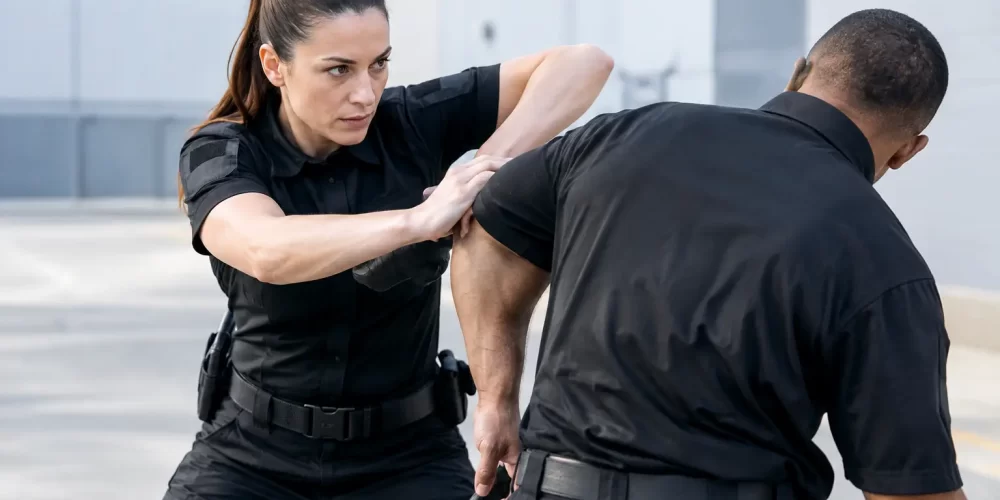
Use of Force Training for Security Professionals
A confrontation can change in seconds: a trespasser refuses to leave, a guest becomes aggressive, or a workplace dispute turns physical. In these moments, use of force is not about proving control. It is about making a lawful, defensible decision that protects people while limiting harm. For security professionals, that decision depends on preparation long before an incident begins.
What Use of Force Means on the Job
Use of force refers to the level of physical intervention used to manage a threat, prevent harm, maintain safety, or carry out a lawful duty. In private security, force should never be treated as a routine response to noncompliance, disrespect, or frustration. The professional objective is to resolve the situation with the least amount of force reasonably necessary under the circumstances.
That standard is practical, not abstract. A guard may need to create distance, give clear verbal commands, call for support, escort someone from a restricted area, or physically defend against an assault. The appropriate response depends on what is happening at that moment: the person’s behavior, the immediacy of the threat, the environment, available resources, and the guard’s legal authority.
Security professionals must also understand the limits of their role. Private security personnel are not law enforcement officers simply because they wear a uniform or work at a sensitive site. Their authority may come from property rights, employer policy, a contract, licensing rules, or applicable local law. Those limits vary by state, province, and jurisdiction. Strong training builds the judgment to recognize when to intervene, when to disengage, and when police or emergency services are the correct next step.
Why Use of Force Training Is a Career Requirement
Good intentions do not replace training. An untrained response can cause unnecessary injury, expose an employer to liability, damage a professional reputation, and turn a manageable incident into a serious one. The same is true when a worker freezes, uses poor communication, or fails to recognize warning signs before violence begins.
Professional use of force training gives personnel a framework for making decisions under pressure. It teaches learners to assess behavior rather than react emotionally, identify escalation cues, communicate boundaries, and choose a response that matches the threat. It also reinforces that force is only one part of conflict management, not the starting point.
For guards, loss-prevention officers, event staff, healthcare workers, and workplace safety personnel, formal certification can strengthen employability as well. Employers want personnel who understand personal protection standards and can explain why they acted. A recognized credential shows that a candidate has invested in responsible response skills rather than relying on instinct or informal advice.
Training is especially valuable for professionals who may add handcuffing, baton, or OC spray duties to their role. Each tool carries serious responsibilities. Certification should cover safe handling, appropriate deployment, aftercare considerations, reporting, equipment control, and the policies that govern its use. Carrying a tool without the training to use it properly creates risk for the professional, the public, and the organization.
The Decision Process Behind a Defensible Response
A defensible response begins with observation. Before acting, a trained professional looks for facts: Is someone making threats? Do they have access to a weapon? Are they attempting to strike another person? Is there a safe exit? Are bystanders at risk? Is the individual impaired, experiencing a mental health crisis, or reacting to a medical condition?
These questions matter because appearance alone is not enough. Someone shouting may be disruptive but not physically dangerous. Someone who is quiet may be preparing to assault a coworker. Professionals must assess actions, capability, proximity, and intent as conditions develop.
The next step is communication. Clear, professional commands can establish boundaries and give a person a chance to comply. A calm voice, appropriate distance, and direct instructions often reduce confusion and prevent a power struggle. Communication should be firm without becoming provocative. Insults, threats, unnecessary physical contact, and sarcastic challenges can rapidly increase resistance.
If the threat continues or becomes immediate, the response must remain proportionate. This does not mean every incident follows a fixed ladder of actions. Real situations are not always orderly, and a person may move quickly from verbal resistance to an assault. It means the professional must be able to explain why a particular level of intervention was reasonable at that time and why lower-risk options were unavailable, ineffective, or unsafe.
Once control is gained, the focus changes. Continued force after a threat has ended can be just as damaging as an excessive initial response. The professional must reassess, separate involved parties, request medical help when needed, preserve the scene, and notify supervision or law enforcement according to policy.
De-Escalation Is Not a Weak Response
De-escalation is often misunderstood as simply being polite. In reality, it is an active safety skill. It involves recognizing emotional escalation, maintaining space, listening for the issue behind the behavior, offering realistic options, and setting clear consequences without inflaming the situation.
A person may calm down when they understand what is expected and what choices remain available. For example, an individual refusing to leave a venue may respond better to a simple explanation of the rule and a clear path to exit than to immediate physical positioning. That approach protects the person’s dignity while allowing security to maintain control of the environment.
De-escalation does not require a professional to ignore danger. If a person is actively attacking, threatening imminent violence, or placing others at immediate risk, delaying action may be unsafe. The skill lies in recognizing the difference between a person who needs time and direction and a person who presents an urgent threat. This is why scenario-based training matters. It develops judgment, not just memorized phrases.
Reporting Is Part of the Response
A use of force incident is not complete when the physical contact ends. Accurate reporting protects everyone involved and is often the strongest evidence of a professional decision. Reports should be written as soon as practical while details are clear.
A quality report describes observable facts rather than conclusions. Record what the person did, what commands were given, what force or restraint was used, the duration of the event, injuries observed, witnesses present, video availability, notifications made, and medical assistance offered or requested. Avoid vague statements such as the person was acting crazy or became hostile. Describe the actual behavior instead.
Professional documentation should also explain the safety concern that required intervention. If a report cannot clearly show the threat, the efforts to gain compliance, and the reason force was necessary, it may create questions later. Facts, timelines, and objective language carry more weight than emotional descriptions.
Build Qualifications Before the Incident Happens
The best time to develop force-management skills is before an assignment puts you in a high-pressure situation. Security work demands more than presence. It requires composure, communication, awareness, policy knowledge, and the ability to act within defined limits.
GC Tactical Training supports professionals who want recognized qualifications in use of force, verbal de-escalation, handcuffing, baton response, OC spray, and workplace safety. Training that combines practical standards with clear completion credentials helps learners demonstrate readiness when pursuing new assignments, advancing within an agency, or meeting employer requirements.
Certification is not permission to act aggressively. It is evidence that a professional has studied the responsibility that comes with authority, equipment, and public trust. Keep your training current, know your site policies, practice communication, and treat every encounter as a decision that may need to be explained later. That mindset protects careers as effectively as it protects people.